

Renaissance Island
There are many dangerous and mysterious places, secret military bases and ghost towns on our planet. Once upon a time, there was a similar facility on Vozrozhdenie Island in the center of the Aral Sea, created for one purpose – the development and testing of biological weapons. Far from populated areas, in a remote location, a military training ground was built with the conditional name "Barkhan", and not far from it, the city of Aralsk-7 was built for scientists and the military.
Fortunately, the landfill was closed long ago, and a few years ago it was razed to the ground, and with it the city. But its history and secrets still arouse the interest of researchers of unusual places. Here we have collected interesting facts and details about the Barkhan training ground and the city of Aralsk-7.
Vozrozhdenie Island was discovered in 1848 during the expedition of A. Butakov, who explored the Aral Sea. The island was named after Tsar Nicholas I, and became Renaissance Island after the formation of the USSR. There were no fresh water sources here, but there were saiga antelopes and waterfowl – it was a safe island for animals. At the very beginning of the 20th century, a small settlement appeared on the island, which served as a temporary camp for fishermen, as well as a small fish factory. A little later, in 1924-1926, kulaks (well-to-do peasants) were exiled to the island.
In 1933, a Military scientific Medical Institute was established in Russia, headed by I.M. Velikanov. The institute's task was to create vaccines for the needs of the army and research dangerous diseases, strains, etc. It was dangerous to engage in such projects in densely populated areas, and a testing ground was needed. The institute itself was set up on Gorodomlya Island on Lake Seliger, 300 km from Moscow, and Vozrozhdenie Island in the Aral Sea was ideal for field research. Vozrozhdenie Island is 150 km away from the nearest cities of Muinak and Aralsk, the risk of accidental visitors is practically eliminated, and in summer the temperature rises above 40 degrees Celsius, and prolonged heat kills many viruses and bacteria.
In 1936, the first scientific expedition landed on the island, exploring the possibility of creating a landfill. The head of the expedition was I.M. Velikanov himself, who is now considered the father of the bacteriological program of the USSR. The following year, the first tests were conducted – scientists studied the effects of several types of infections. We tested the bioagents of tularemia, cholera and plague as biological weapons and tested vaccines against these diseases. In 1938, Velikanov was repressed and shot, which had a negative impact on scientific research.
In 1941, the Great Patriotic War began, and many enterprises of the Soviet Union began to be evacuated to the east of the country. This has affected laboratories and institutes. And on Vozrozhdenie Island in 1942, a biological weapons testing ground was again organized and scientists were temporarily housed.
The full-fledged launch of the military scientific complex on Vozrozhdenie Island took place only in 1948. All fishermen and other local residents were evicted from the island, and the fish factory was closed. A military unit with barracks to accommodate 800 military personnel and a small town for scientists and their families were built on the island. The city was named Aralsk-7 (the second name is Kantubek). It houses 15 three-storey houses, a club for cultural events, a canteen, shops, a stadium, a parade ground and its own power plant.
In 1949, an airfield with 4 runways was built 3 km west of the city, similar to the wind rose, since strong, changeable winds always blew on Vozrozhdenie Island. The airfield was named "Barkhan". At the same time, a laboratory complex was built 3 km southwest of the city, where scientists traveled daily. The field test site is located 15 km to the south, on the very edge of the island.
The island became one of the most secret facilities in the USSR. It was forbidden to approach it, and only during severe storms were fishermen who happened to be nearby allowed to wait out a natural disaster in one of the bays without going ashore. Although the island was located on the territory of the Uzbek SSR, it was provided by the Kazakh SSR. A closed military town, Aralsk-5, was built 5 km northwest of the Kazakh port of Aralsk (there are also versions of Aralsk-6 and Aralsk-8), which serviced the island and delivered fresh water, fuel and food.
Life on the island was like an ordinary frontier garrison. The military guarded the territory, and the city had a regular, measured life: children went to kindergarten and school, parents went to work in the laboratory, in the evenings residents gathered at a club where movies were shown, and on weekends families had picnics on the shore. The only disadvantages were the hot desert climate and the closeness of the city.
However, for all the mundane life of the city and the island, it was one of the scariest and most dangerous places in the USSR. The laboratory complex with the official name PNIL-52 (field research laboratory No. 52) was a repository of the deadliest viruses, infections, and their man-made modifications. Horses, sheep, dogs, rats, and even monkeys were used for testing. It is well known that shipments of chimpanzees and other primate species were shipped from Africa. Unfortunately, all these animals have become victims of biological weapons tests.
The tests themselves took place 15 km south of the laboratory: the animals were tied up and sprayed with strains of viruses and infections using aircraft or bombs. Scientists observed the rate of spread and development of diseases, as well as studied the consequences of their terrible experiments.
Over the past 50 years, Vozrozhdenie Island has conducted tests with diseases such as anthrax, plague, smallpox, tularemia, brucellosis and others. We will never know the exact list of diseases and strains, but it is known that this test site was the central site of field testing, and biological weapons variants were sent here from all over the USSR – samples were sent from the secret cities of Stepnogorsk, Kirov-200, Sverdlovsk-19, Omutninsk, Zagorsk-6 and others.
Already in 1960, the water level in the Aral Sea began to drop, which increased every year. The area of Vozrozhdenie Island began to increase, and the coastline began to move away from the city. Over time, the airfield became the only way to communicate with the island, as the delivery of water and provisions by barge became impossible. Renaissance Island has increased 10 times in 30 years! In 1960, the area was 216 square kilometers, and in 1990 it was already more than 2,000 kilometers. At the beginning of the 21st century, the island turned into a peninsula, and in 2009 it completely merged with the mainland.
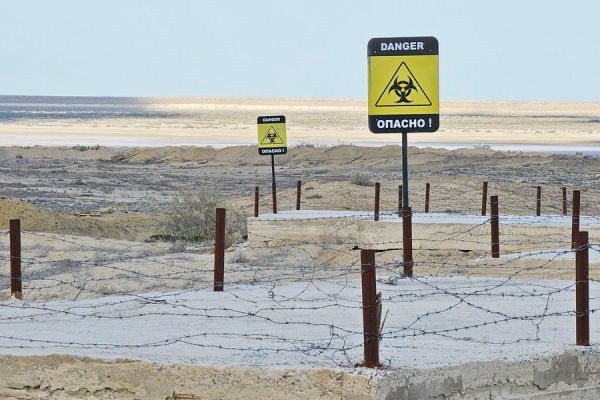
In 1988, the Barkhan landfill was turned into a biological weapons burial ground. Tons of biological weapons called Anthrax-836, which is based on anthrax, were buried on Vozrozhdenie Island. Also, there have already been numerous burials of animals that have become victims of experiments.
In 1991, Uzbekistan gained independence, and the USSR collapsed. But the city and the military unit continued to exist and were under Russian control. Fortunately, in the new realities, the development of biological weapons has become irrelevant, and the city of Aralsk-7 has lost its importance. In November 1991, the laboratory was closed, and in early 1992, the entire population was evacuated. Aralsk-7 has turned into a ghost town.
In 1995, at the invitation of the authorities of Uzbekistan and Kazakhstan, Aralsk-7 was visited by American scientists who conducted research on the burial of dangerous substances. They found out that some spores and bacteria did not die, despite the heat and disinfection of the burial grounds. There were similar expeditions in 1997, 1999 and 2002. American bacteriologists have also tested the effectiveness of their vaccines against bioagents of anthrax and other diseases. In 2018, the city was visited by journalists from Tashkent, who made the last photo report about Aralsk-7.
By 2021, the city of Aralsk-7 and the laboratory complex 3 km away were completely destroyed by the Uzbek authorities, and today only traces of foundations and the cross-shaped stripes of the Barkhan airfield remind of this secret facility. The top-secret city turned into history, but over the years after its declassification it has grown into legends, and has also become a hero of computer games. The developers of the games Call of Duty and World of Tanks have created locations inspired by this mysterious place in the heart of the Aral Sea.
It is unlikely that a reasonable person would willingly want to be in such a place. Despite all the security measures taken, it is impossible to guarantee that some virus or bacterium will not escape from the burial grounds of Vozrozhdenie Island. Perhaps it will be safe here in decades, but is it worth trying your luck? It's better not to take any chances and never approach this place.