

The Military Assembly Building
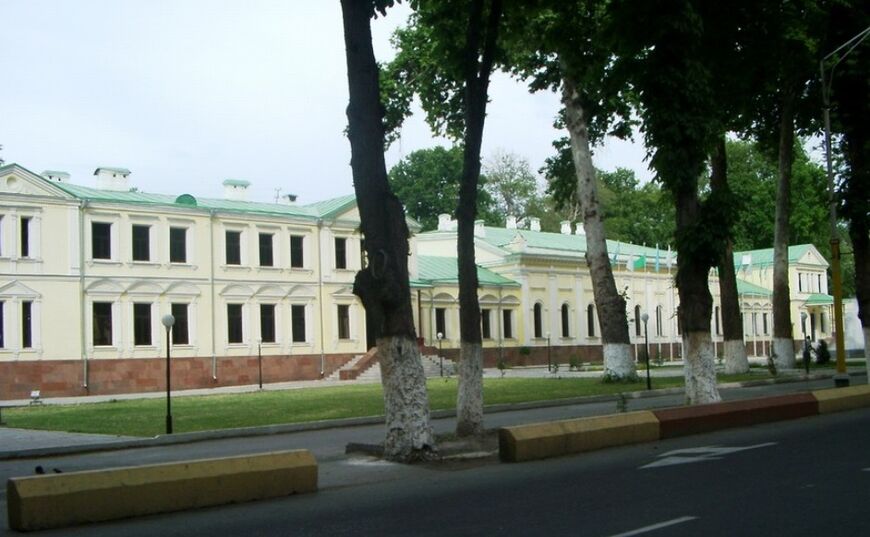
Ferghana owes much of its layout to the military civil engineer Sinclair, who also organized the project for which the military assembly building (now called the "House of Officers") was built. The building is one of the oldest in the city.
Construction history
Along with the first public buildings in Ferghana, the foundation of the Garrison Officers' House was laid in 1878. The construction was completed just a year later, and in pre-revolutionary times, the house of officers was called the "Military Assembly." After the revolution, the "House of the Red Army", then the "House of the Soviet Army", and now the building is called the "House of Officers".
The design of the military assembly building belongs to the military engineer Sinclair. Thanks to his high-quality education, complemented by his own talent, he managed to create a beautiful and memorable building in the center of Ferghana. Moreover, it is thanks to Sinclair that the city has such a well-thought-out layout and conveniently arranged streets. Later, during the Soviet era, several extensions were added to the military assembly building. They slightly violated the original architectural concept and symmetry, but at the same time extended the length of the facade, which helped to visually add significance to the building. There is a city park behind the semicircular rotunda.
The fate of the building
This name was given to the building quite justifiably, because there were a large number of military personnel in Ferghana. There were especially many officers here. There were two halls in the building of the military assembly: a dance hall and an auditorium, as well as a library, billiard room and recreation rooms. And in the evenings, this place turned into a kind of club for officers and other residents of the city.
Since its foundation, brass concerts have been held in the military assembly building. Military bands performed, which were always fully staffed (about 140 people). Many musicians and military conductors had musical education. The concerts were attended by the entire intelligentsia of the city, including family members of the officers, and music lovers. These events made a great contribution to the cultural life of the city.
During the Soviet era, the military assembly building still served two functions: It was a hotbed of culture for the townspeople and a venue for both ideological and professional, as well as mass events for officers. Only the building was now called the "House of the Red Army" (1920-1930s), and later the "House of the Soviet Army" (1940-1980s). But regardless of its name, this place remembers the sending of soldiers to the front during the Great Patriotic War, meetings of the military command, and also those who served in Ferghana during the war. From letters and other archival documents, one can trace the stories of people who began their service in the city as young lieutenants, and often ended up serving here, but already as commanders of units or formations.
The military assembly building somehow passed through the life of almost every resident of Ferghana in those days: New Year's trees were held there for children, dances for boys and girls, film screenings, concerts and creative evenings for men and women. His activities were very diverse and not always related to military events. In addition to cultural events, dances, performances, movies, and concerts, sports competitions (in table tennis and boxing), studios, and courses were also organized here. Art and philatelic exhibitions were held. Exhibitions and dog shows for dog breeders were held in the park at the current Officers' House. Before the widespread appearance of catering establishments, the building also had a summer buffet, where employees of nearby establishments came for lunch, and after work it was pleasant to drink draft beer.
In the post-war period, the main vocation of the staff of the House of Officers was, of course, dance evenings. Their program was sometimes posted in advance, and for young people it was a special way of life and recreation. It happened that during the evening the dance hall could accommodate about 500 people, in the summer they danced in the park outdoors, and the music was often performed live.
In 1998, the Officers' House was renovated: the walls were refreshed and updated, both porches were returned to their original appearance, the basement was laid with stone, the adjacent park was put in order and redeveloped.




Place on the map
Tours where you can visit this place:
The Military Assembly Building
Tashkent — Bukhara — Samarkand — Kokand — Ferghana — Margilan — Chimgan — Rishtan
- 880$
- 8d.

The Military Assembly Building
Tashkent — Bukhara — Samarkand — Khiva — Ferghana
- 640$
- 7d.
The Military Assembly Building
Tashkent — Bukhara — Samarkand — Khiva — Kokand — Ferghana — Nukus — Urgench — Khorezm — Chimgan — Rishtan
- 1340$
- 11d.