Monument "Courage"
The monument "Courage" is one of the main symbols of Tashkent's history in the 20th century, located in the city center. This is a dramatic monument associated with one of the black dates in the annals of the country – it is dedicated to the people who were able to survive the disaster and the people who helped overcome those difficult times.
On April 26, 1966, at 5:23 a.m., Tashkent was awakened by the terrible roar of powerful tremors. An earthquake of magnitude 5.2 on the Richter scale occurred directly under the city, at a depth of 5 km. The strong tremors lasted only 10-15 seconds, but it was enough to destroy thousands of houses, leaving 300,000 people without a roof over their heads. Fortunately, there were very few deaths – the data varies from 8 to 13 people, and some of these people died of a heart attack.
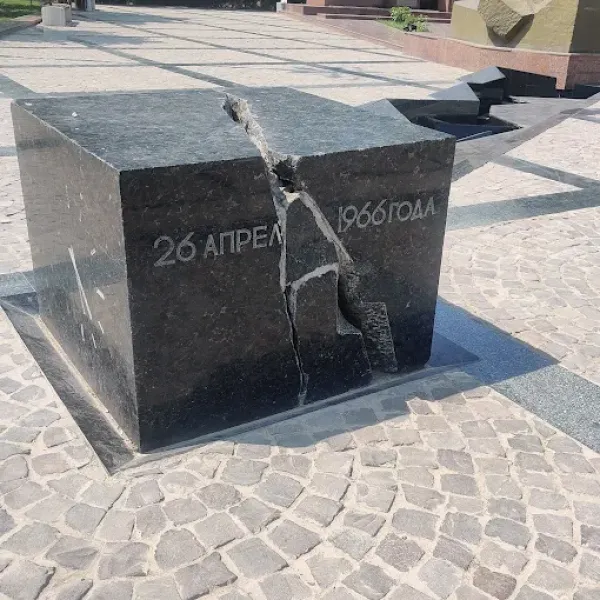
At the same moment, humanitarian aid was sent to Tashkent, tent camps were erected, and debris removal began. And very soon, builders from all over the USSR went to the capital of Uzbekistan to rebuild the city. And it took a record 3.5 years. The appearance of Tashkent has changed – instead of vast single-storey adobe blocks, 4-5-storey districts of burnt brick and concrete have appeared. After all the trials that the residents of the city endured, and in honor of the builders who rebuilt Tashkent, on May 20, 1970, the memorial complex "Courage" was opened right on the site of the epicenter of the earthquake.
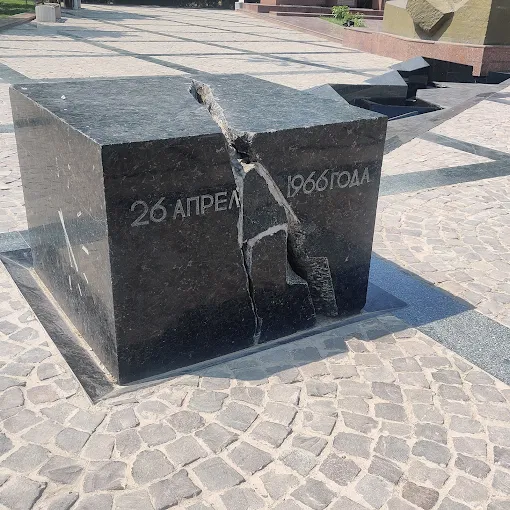
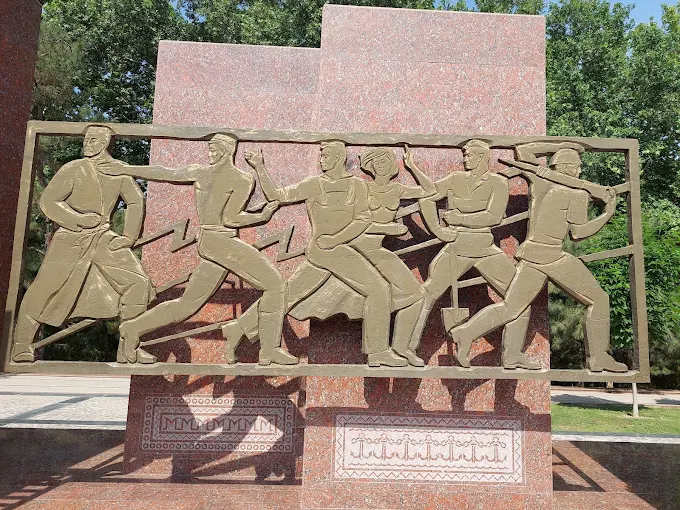
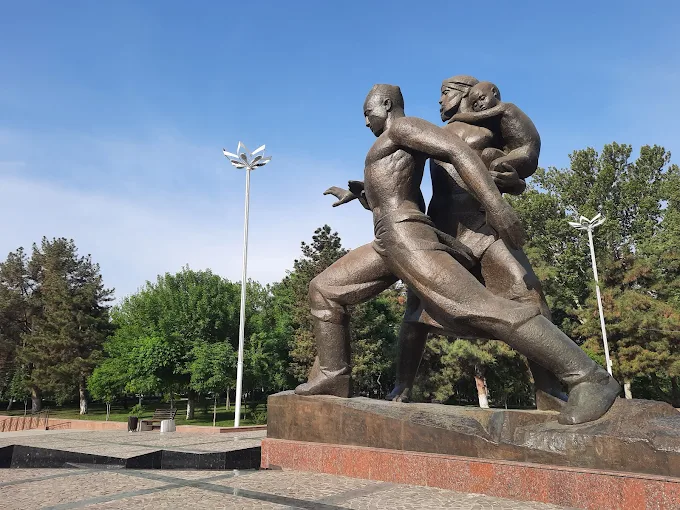
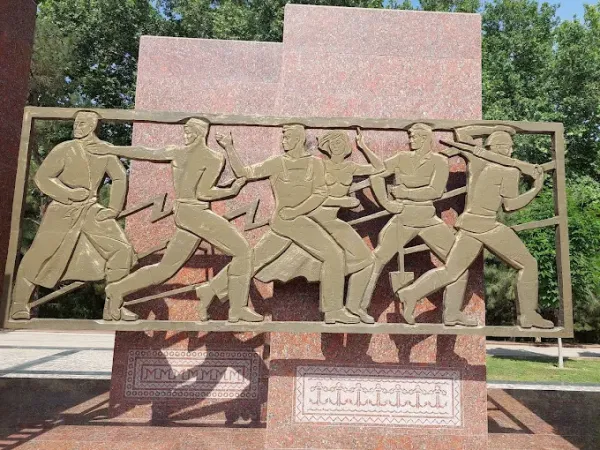
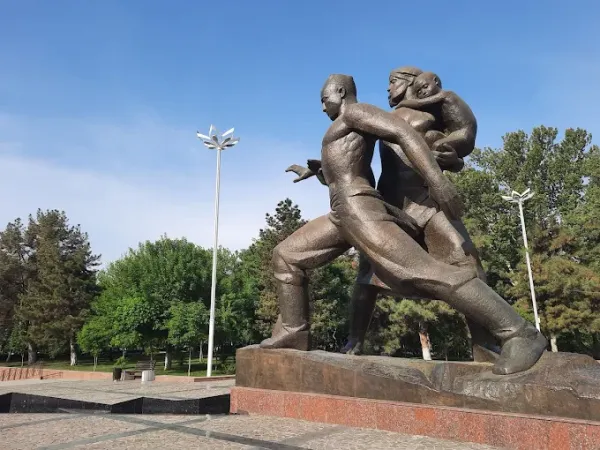
The monument "Courage" consists of three parts: a black cube with the date and time of the Tashkent earthquake, a bronze sculpture of a man and a woman with a child in their arms, 14 steles with bronze reliefs telling about the restoration of the city. From the gloomy black cube with a crack, there is a heaving zigzag split towards the family, where a man and a woman put out their hands to protect themselves from the elements. Behind them, rays of marble paths radiate to the bas-reliefs symbolizing the 14 union republics of the USSR that came to the aid of Tashkent. The architect of the memorial was Sabir Adylov, who later made a great contribution to the look of Soviet Tashkent in the 1970s and 1980s. The image of a stable family was created by the Russian sculptor Dmitry Ryabichev.
Today, the monument "Courage" is one of the popular recreation spots in Tashkent. Behind it is a small park, which houses the Museum of Olympic Glory, originally the Museum of Friendship of the Peoples of the USSR, opened in 1976. Today, this park is connected by a white cable-stayed bridge over the Ankhor Canal with the Navruz Ethnographic Park, where you can ride the largest Ferris wheel in Tashkent, visit workshops and shops of Uzbek clothing and souvenirs.
The monument "Courage" can be called a symbol of the renaissance and new history of Tashkent, because the natural disaster gave rise to the construction. A new architectural style has been formed in the city – seismic modernism, which can be seen today on the examples of the Tashkent TV Tower, the Tashkent Metro, the Peoples' Friendship Palace, the Museum of the History of Uzbekistan, the Pearl House and other buildings of that era.
Only a few 100-year-old houses, reinforced with channels and brick wall supports, remind of the distant earthquake of 1966 in the city today. And in the monument "Courage", only a gloomy black cube with a carved date and clock is dedicated to the catastrophe. Otherwise, the memorial has become a symbol not of tragedy, but of perseverance in the face of hardships and the memory of selfless help. Almost all newlyweds come here after the registry office to take a photo as a souvenir – this is an integral part of the traditions of the Tashkent people. And every evening, families walk here, dates are arranged, and carefree children play.



Place on the map
Tours where you can visit this place:
Monument "Courage"
Tashkent — Bukhara — Samarkand — Shakhrisabz
- 720$
- 7d.
Monument "Courage"
Tashkent — Bukhara — Samarkand
- 640$
- 7d.
Monument "Courage"
Tashkent — Bukhara — Samarkand — Khiva — Khorezm
- 730$
- 7d.
Monument "Courage"
Tashkent — Bukhara — Samarkand
- 500$
- 5d.

Monument "Courage"
Tashkent — Bukhara — Samarkand — Khiva
- 590$
- 6d.
Monument "Courage"
Tashkent — Bukhara — Samarkand — Shakhrisabz
- 1150$
- 7d.
Monument "Courage"
Tashkent — Bukhara — Samarkand — Khiva — Shakhrisabz — Gizhduvan
- 1200$
- 10d.
Monument "Courage"
Tashkent — Bukhara — Samarkand
- 675$
- 5d.