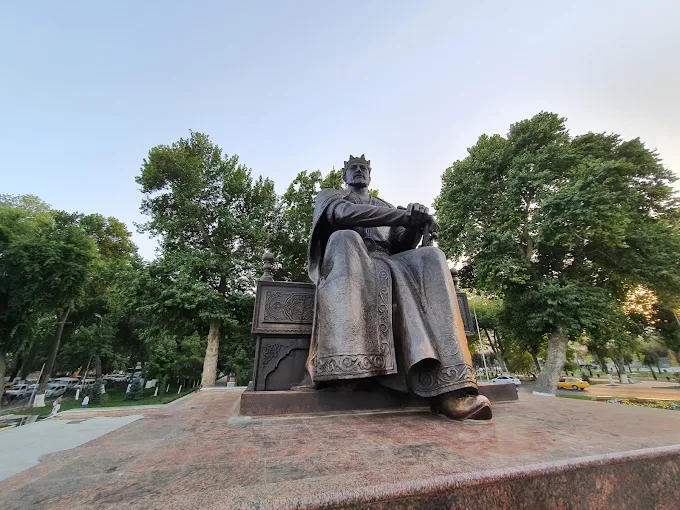
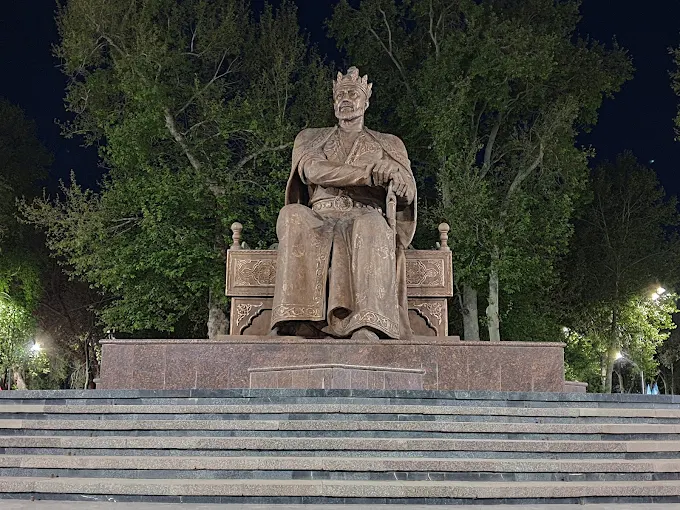

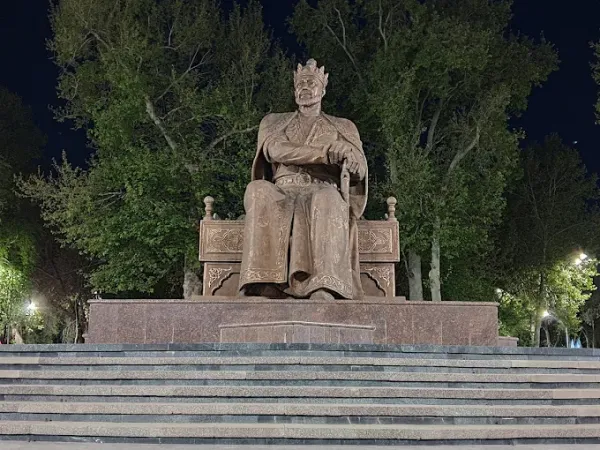
Monument to Amir Temur
A monument to Amir Timur (Tamerlane) has been erected in front of the Gur Emir Mausoleum at the intersection of major city roads. The greatest conqueror of Central Asia, who did not lose a single battle and conquered peoples from Turkey to India.
Amir Timur was born in 1336 in the city of Kesh, which is now called Shakhrisab. He was the son of the leader of one of the influential Barlas tribes. By 1370, Timur had defeated all rivals in the area of the Uzbek interfluve (the Amu Darya and Syr Darya rivers). He did not belong to the Genghisid family and could not be called the Great Khan, so he always called himself the Emir (leader), however, in 1370 he became related to the descendants of Genghis Khan.
The first major victory of Timur, who became known in Europe as Tamerlane, took place in 1380, when he captured Khorezm and Kashgar. The large state of the Golden Horde remained independent for the time being, but he helped Khan Tokhtamysh overthrow Mamai and take the throne. The following year, in 1381, he captured Herat, subjugating all of Persia.
The final conquest of the Golden Horde and its incorporation into the Timur state occurred only by 1395. At this time, Timur, pursuing the troops of Khan Tokhtamysh, reached the borders of Russia and planned an invasion, but uprisings broke out in Persia and Timur turned back without entering Russia.
In 1399, Timur completely conquered India. The city of Delhi was destroyed with extreme brutality. However, like most other cities that resisted Timur's troops. In general, Timur's attitude towards prisoners and the vanquished was extremely cruel, which was reflected by the Russian artist Vereshchagin in the painting "Apotheosis of War". This painting, with a mountain of skulls of the defenders of the defeated city, is kept in the Tretyakov Gallery in Moscow.
The last significant campaign was in Asia Minor, during which Tamerlane defeated the troops of Sultan Bayezid in 1402 in the battle of Ankara. At that time, Bayezid was besieging Constantinople, but was defeated by Timur, and he was captured, where he died after spending several years in an iron cage. This delayed the fall of the Byzantine Empire by 50 years, and Constantinople was finally conquered by the Turks only in 1453. During this campaign, Timur captured and burned many cities in the Middle East.
In 1405, Timur set out on his longest campaign to China, but immediately after the troops left, he fell ill and died on January 19, 1405. Timur was buried in the Gur Emir Mausoleum, located near the monument. Rukhabad Mausoleum is also nearby, and Registan Square is within walking distance.




Place on the map
Tours where you can visit this place:
Monument to Amir Temur
Tashkent — Bukhara — Samarkand — Shakhrisabz
- 720$
- 7d.
Monument to Amir Temur
Tashkent — Bukhara — Samarkand
- 640$
- 7d.
Monument to Amir Temur
Tashkent — Bukhara — Samarkand — Khiva — Khorezm
- 730$
- 7d.
Monument to Amir Temur
Tashkent — Bukhara — Samarkand
- 500$
- 5d.

Monument to Amir Temur
Bukhara — Samarkand — Shakhrisabz
- 480$
- 5d.

Monument to Amir Temur
Bukhara — Samarkand — Khiva
- 440$
- 5d.

Monument to Amir Temur
Tashkent — Bukhara — Samarkand — Khiva
- 590$
- 6d.
Monument to Amir Temur
Tashkent — Bukhara — Samarkand — Shakhrisabz
- 1150$
- 7d.