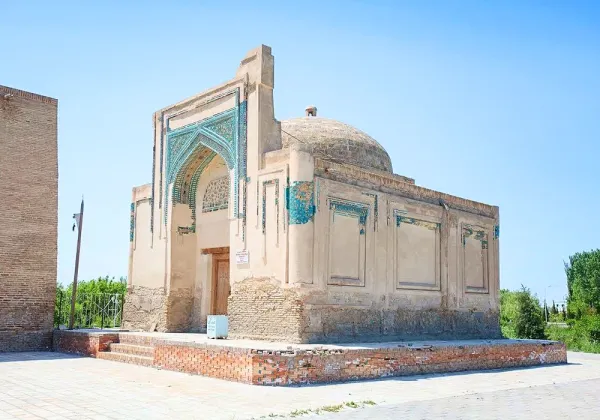
Mausoleum of Sufi Sayf al-Din Boharzi and Buyan Kulikhan
The emergence and functioning of the Khanaka Sufi monastery in Kasaba (suburb) Fatahabad falls during one of the most difficult periods in the history of Central Asia - the first decades of the 13th century after the Mongol conquest, when large areas of Central Asia were destroyed and devastated by the Tatar Mongols, the economy was undermined, and the process of adapting to the new government, laws and orders was underway.
The Mongol conquest had a direct impact on the spiritual life of the local population. The cultural level of the conquerors was lower than that of the peoples of Central Asia, which affected the relationship between the aborigines and the aliens who ruled the country.
In the 13th century, Central Asia came under the rule of non-Muslim rulers, and at some stage Islam lost its status as the state religion here. The Mongol conquest displaced the role of Islam in the conquered countries, “tombs of saints” and various kinds of mazars came to the fore, and the importance of the “cult of saints" increased. Sufis displaced the Ulama and became authoritative representatives, heralds of a new type of religion. The influence of the Sufis did not stop even after death due to the increased role of the "cult of saints", the worship of their graves. During this period, the tomb, not the mosque, served as a symbol of Islam.
The tomb, as well as the abode of the dervishes and the circle of dhikr participants, became external forms of expression of a living religion for Iranians, Turks and Tatar-Mongols.
It was at this historical moment that a Sufi khanaka arose in Fatahabad near Bukhara, founded by the Kubrawi Sheikh Sayf al-Din Boharzi. After his death in 1261, the “Sheikh of the Sheikhs of the world,” as he was called, was buried in a special tomb on the territory of the khanaka. The tomb of the sheikh, which embodied the “cult of saints” in Islam, became an object of worship for many subsequent centuries - the ideological center of the charity khanaka in Fatahabad and one of the sources of its economic well-being.
The Sufi khanqah in Fathabad took shape at the beginning of the tenth century, some time later, apparently after the formation of the Kubrawiya Brotherhood (tariqa) in Khorezm, founded by Najm al-Din al-Kubra. Kubraviya represented the Central Asian school of mysticism, was traditionally Sunni, extended its activities up to the borders of western China and operated up to the XVIII century.
Sayf al-Din Boharzi was a murid (student) Najm al-din Kubra, his follower and propagator of al-Kubra's ideas. Quiet and loud dhikr, sama chants were practiced in the khanaq, and the ideas of al-Kubra were preached – ritual purity, fasting, silence, withdrawal from the world, and mental remembrance of God. As in Tariqa Kubrawiya, in the Fathabad community, the authority of the chief sheikh (Caliph) was hereditary, all the descendants of Sayf al-Din Boharzi were sheikhs, stood at the head of the monastery in Fathabad.
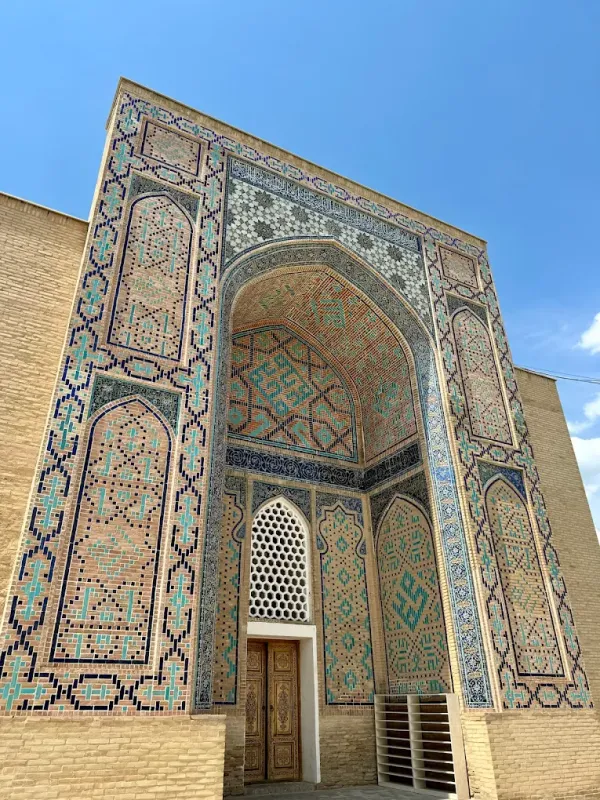
The mausoleum attracts attention by the grandeur of its forms, the scale of its construction, and the exceptional simplicity and clarity of its architectural idea. This building has a more complex plan, with a purkhana tomb and a ziarathona memorial room. Two domes above them form the profile of the building. The mausoleum is practically devoid of decoration, but this is more than covered by the richest decorative elements of the monument – a magnificent tombstone standing in the gurkhana room. This tombstone, with its amazing subtlety and versatility of design, boundless intricacy of intertwining floral ornaments and intricate Arabic inscriptions, is a true masterpiece of medieval wood carving.




Place on the map
Tours where you can visit this place:
Mausoleum of Sufi Sayf al-Din Boharzi and Buyan Kulikhan
Tashkent — Bukhara — Samarkand — Shakhrisabz
- 720$
- 7d.
Mausoleum of Sufi Sayf al-Din Boharzi and Buyan Kulikhan
Tashkent — Bukhara — Samarkand
- 640$
- 7d.
Mausoleum of Sufi Sayf al-Din Boharzi and Buyan Kulikhan
Tashkent — Bukhara — Samarkand — Khiva — Khorezm
- 730$
- 7d.
Mausoleum of Sufi Sayf al-Din Boharzi and Buyan Kulikhan
Tashkent — Bukhara — Samarkand
- 500$
- 5d.

Mausoleum of Sufi Sayf al-Din Boharzi and Buyan Kulikhan
Bukhara — Samarkand — Shakhrisabz
- 480$
- 5d.

Mausoleum of Sufi Sayf al-Din Boharzi and Buyan Kulikhan
Bukhara — Samarkand — Khiva
- 440$
- 5d.

Mausoleum of Sufi Sayf al-Din Boharzi and Buyan Kulikhan
Tashkent — Bukhara — Samarkand — Khiva
- 590$
- 6d.
Mausoleum of Sufi Sayf al-Din Boharzi and Buyan Kulikhan
Tashkent — Bukhara — Samarkand — Shakhrisabz
- 1150$
- 7d.