Magoki Attari Mosque
The oldest mosque in Bukhara, Magoki Attori, is located in the center of Bukhara to the west of the famous Lyabi Hauz Square.
Its construction in 714 is associated with the name of the Arab sheikh, governor of Khorasan, Qutaybah ibn Muslim, one of the first people who brought Islam to the territory of Central Asia. Even before the arrival of the Arabs, a bazaar was located in Bukhara on the site of the mosque, where, before the establishment of Islam, Zoroastrian idols, medicinal herbs and spices were sold here. And in the beginning, this place was called Bozori Attoron. The iconic Zoroastrian temple of the Moon was also located here.
In order not to drown out the history of the area, built on the site of the destroyed temple of the Zoroastrian mugs, the mosque was named Magoki Attori.
During its long history, the Magoki Mosque has survived several major fires and has been reconstructed more than once, the last construction was carried out at the beginning of the XII century.
In 1541, the Bukhara Khan Abdulazikh Khan wanted to demolish the mosque, since by that time it was heavily sunk into the ground and the front part of the portal was partially destroyed, but the leader of the Naqshbandi Sufi order, Sheikh Mahmudi Azam, prevented him.
In the early Middle Ages, the ancient Mokh Bazaar was also located here. In the 1930s, scientists excavated and discovered the remains of a carved decoration and foundation from the period of the 10th century. The southern portal of the mosque with unique blue ornaments and carved majolica was opened here under a layer of soil.
Later, during the late Middle Ages, Magoki Attori served as a neighborhood mosque with an entrance facing the Lubi House.
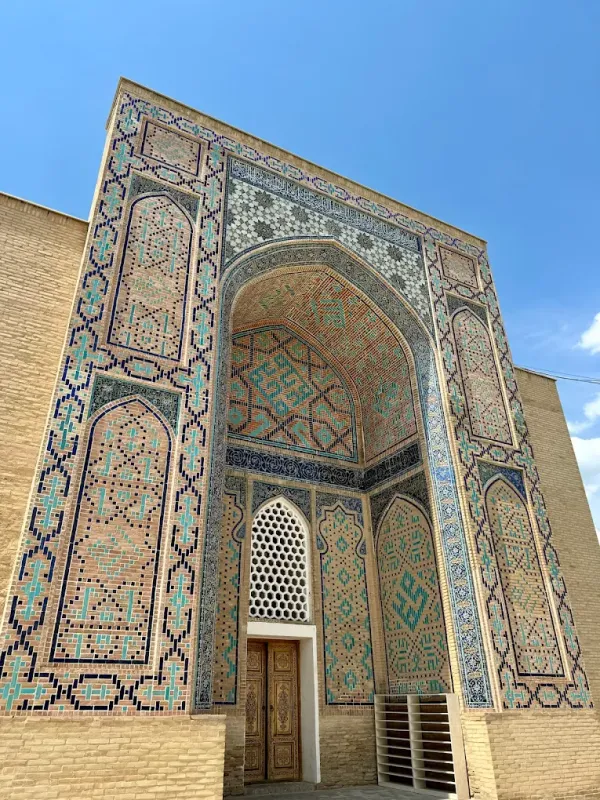
Today, the lower portal in the form of an arch, decorated with stalactites, has been preserved from the facade of the ancient mosque.
The double quarter columns on the sides of the portal are an echo of the pre–Islamic era, and the decorative decoration of five carved gancha slabs with exquisite compositions in the form of an elegant ornament speaks of the power and greatness of the world of Islam on this earth.
Today, the Magoki Attori Mosque is included in the UNESCO World Heritage List as part of the historical center of Bukhara.




Place on the map
Tours where you can visit this place:
Magoki Attari Mosque
Tashkent — Bukhara — Samarkand — Shakhrisabz
- 720$
- 7d.
Magoki Attari Mosque
Tashkent — Bukhara — Samarkand
- 640$
- 7d.
Magoki Attari Mosque
Tashkent — Bukhara — Samarkand — Khiva — Khorezm
- 730$
- 7d.
Magoki Attari Mosque
Tashkent — Bukhara — Samarkand
- 500$
- 5d.

Magoki Attari Mosque
Bukhara — Samarkand — Shakhrisabz
- 480$
- 5d.

Magoki Attari Mosque
Bukhara — Samarkand — Khiva
- 440$
- 5d.

Magoki Attari Mosque
Tashkent — Bukhara — Samarkand — Khiva
- 590$
- 6d.
Magoki Attari Mosque
Tashkent — Bukhara — Samarkand — Shakhrisabz
- 1150$
- 7d.