
Gur-Emir Mausoleum
Gur Emir (translated as the grave of the emir, the ruler, i.e. Timur) - the place where Amir Timur, his sons and grandchildren are buried. Initially, the mausoleum was intended only for Timur's grandson, Muhammad Sultan, who died young in 1403, during a military campaign. Timur, shocked by the death of his beloved grandson, whom he saw as the heir to the throne, ordered the construction of a mausoleum on the territory of the Tsarevich Mohammed Sultan ensemble. He was his grandson from Jehangir's eldest son and replaced Timur in his absence, being considered his successor on the throne.
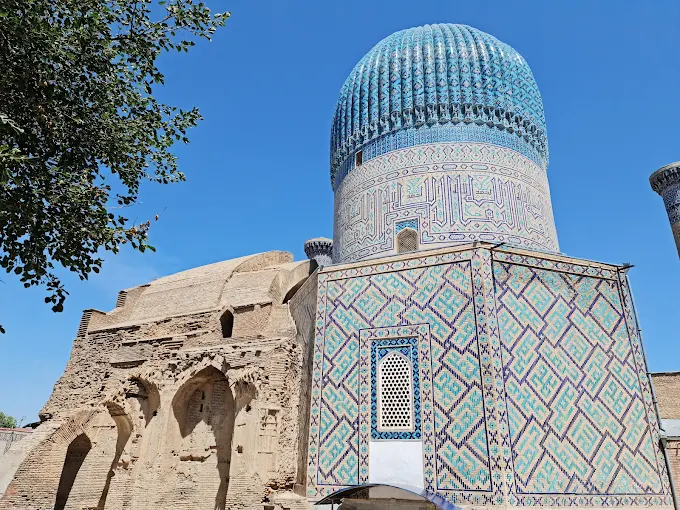
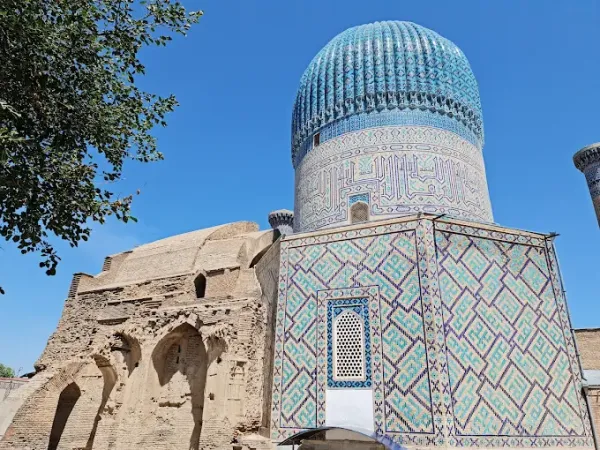
It is a single-domed building with a crypt. The mausoleum is based on an octagon with a ribbed dome (D-145m, B-12.45) on a high drum, which is the pride and decoration of the mausoleum. Powerful harnesses, maximally saturated with blue and blue tones, give special expressiveness.
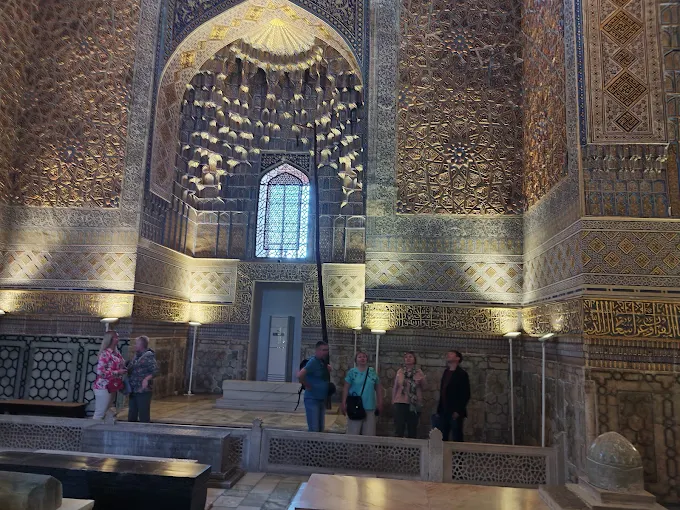
The interior of the mausoleum, built by Ulugbek in 1424, is grandly and magnificently decorated. The ornamental painting is made with a special technique, relief papier-mache palmettes with abundant gold leaf gilding. The panels are lined with onyx gemstone.
Behind a low patterned marble lattice, the tombstones of Amir Timur, his sons Shahrukh and Miranshah, his grandchildren Muhammad Sultan and Ulugbek, and great-grandchildren (two young sons of Ulugbek) are placed in strict order at the feet of Amir Timur's spiritual mentor, Sheikh Seyid Bereke. The gravestone of Amir Timur, carved from a whole block of dark green jade, is set by Ulugbek and containing the ruler's family tree. Under the floor there is a vaulted crypt with burials, in the same order as the decorative tombs.
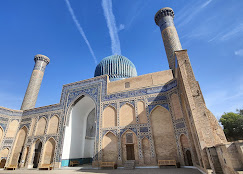
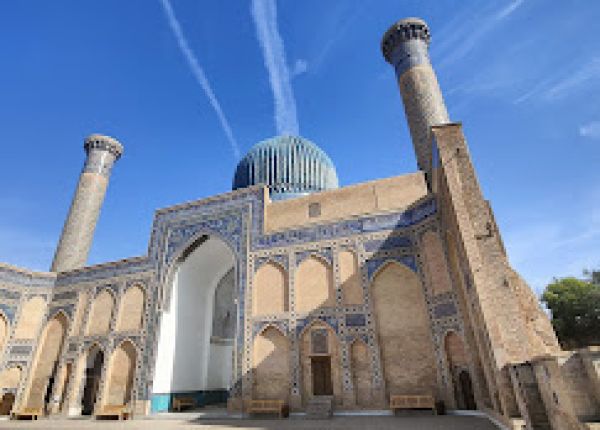
On the territory of the courtyard there is the famous Kok-Tash throne stone, transferred from the citadel (fortress of Timur), over which representatives of the Sheibanid dynasty (XVI century) were crowned.
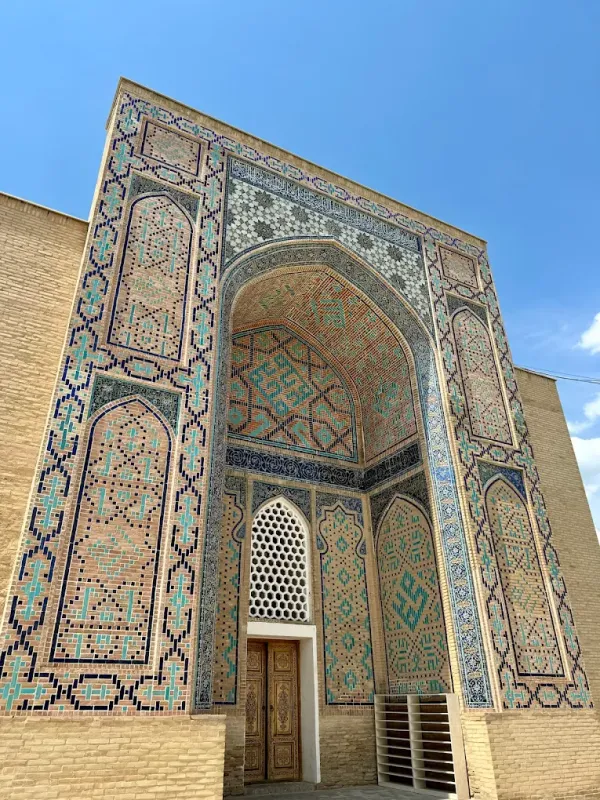
The grandeur and lightness of architectural lines and shapes, the richness of multicolored mosaics, the monumentality and harmony of proportions, and the painted decorative coating of the interior made the Gur Emir Mausoleum a unique monument of Central Asian architecture.
In June 1941, studies were conducted on the remains of those buried in the Gur-Emir mausoleum, which showed that Timur, Ulugbek, Shahrukh, Miranshah and Mohammed Sultan were indeed buried in the mausoleum. The sculptor-anthropologist M. Gerasimov was able to restore the facial features of Tamerlane and Ulugbek. In addition, information was confirmed that Tamerlane was a giant for his time (his height was about 180 cm) and that he limped very badly when walking. Later, the reliability of historical information regarding the murder of Ulugbek and the authenticity of other graves was also confirmed. After all the work was completed, the remains were reburied.
There is a legend that Tamerlane's grave could not be opened, so as not to release the spirit of the militant Temur. It may be a coincidence, but Tamerlane's grave was opened on the night of June 21-22, 1941. On June 22, at 4 a.m., Nazi troops invaded the territory of the USSR. The bloodiest war in our history, the Great Patriotic War, has begun…




Place on the map
Tours where you can visit this place:
Gur-Emir Mausoleum
Tashkent — Bukhara — Samarkand — Shakhrisabz
- 720$
- 7d.
Gur-Emir Mausoleum
Tashkent — Bukhara — Samarkand
- 640$
- 7d.
Gur-Emir Mausoleum
Tashkent — Bukhara — Samarkand — Khiva — Khorezm
- 730$
- 7d.
Gur-Emir Mausoleum
Tashkent — Bukhara — Samarkand
- 500$
- 5d.

Gur-Emir Mausoleum
Bukhara — Samarkand — Shakhrisabz
- 480$
- 5d.

Gur-Emir Mausoleum
Bukhara — Samarkand — Khiva
- 440$
- 5d.

Gur-Emir Mausoleum
Tashkent — Bukhara — Samarkand — Khiva
- 590$
- 6d.
Gur-Emir Mausoleum
Tashkent — Bukhara — Samarkand — Shakhrisabz
- 1150$
- 7d.