

Gaukushon Madrasah
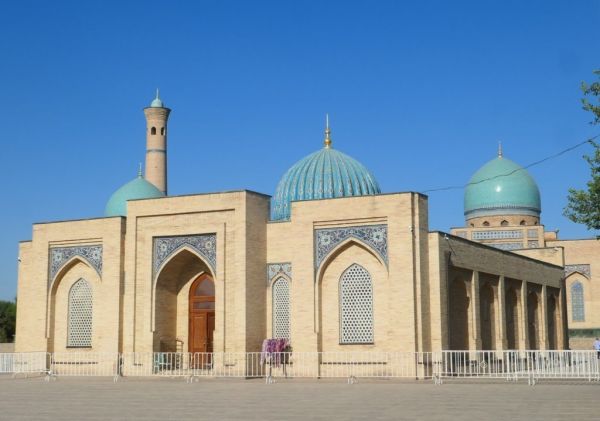
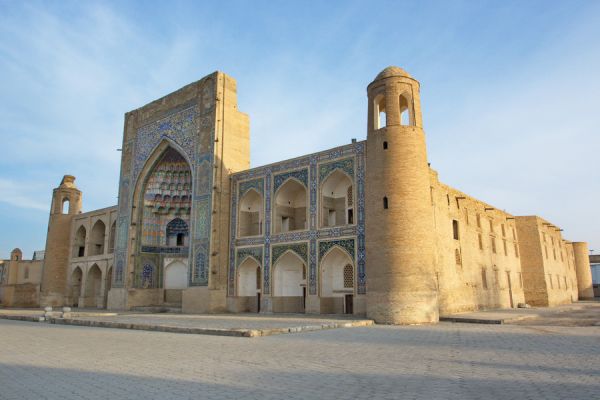
Khoja Gaukushon (Khoja Gaukushan Ensemble) is one of the largest ensembles in the city center of Bukhara.
Together with a number of other buildings in the central part of the city, it is included in the UNESCO World Heritage List.
Gaukushon — "killing bulls", in the past a large shopping area of Bukhara, on the site of which there was previously a slaughterhouse. In the 16th century, a large madrasa and a cathedral mosque were built on the square with a high and wide minaret of Khoja Kalon, which was second in size only to the Kalyan minaret of the 12th century.
Gaukushon Madrasah was built in 1570 during the reign of Uzbek Khan Abdullah Khan II and had a traditional courtyard scheme. The trapezoidal shape of the building is explained by its location at the fork of the streets
The buildings on Gaukushon Square were built at the expense of the Juybara sheikh Khoja Said, known by the nickname "Khoja Kalon" ("great Khoja"), which is reflected in the name of the mosque and the whole complex. The Khoja Kalon madrasah was built in 1570 at a fork in the streets, which explains its trapezoidal shape, which, however, did not prevent the preservation of the traditional courtyard scheme. In 1598, a cathedral mosque (masjid-i jami), called the "Khoja Mosque", was built to the north of the madrasah. The builder of the cathedral mosque, Khoja Kalon, is buried on the territory of the family necropolis of the Juybar sheikhs - Chor-Bakr.
This ensemble belongs to the architecture of medieval Bukhara, during the reign of the first khans of the Sheibanid dynasty, when the capital was moved from Samarkand to Bukhara.
The masters of the Bukhara School of Architecture of the XV—XVII centuries used inexpensive and labor-intensive, but effective and effective techniques in building structures and decor. For example, overlappings on intersecting arches, two-tone gancha decor "kyrma" and "chaspak". In the 17th century, colorful, sometimes monumental zoomorphic images with ancient pre-Muslim subjects were used in majolica decoration, where the pattern of birds and bird snakes flying towards the sun prevailed. The features of the Bukhara school stand out especially vividly in the buildings of madrassas, minarets, sardobas and memorial buildings — khazira. The Bukhara school, becoming the leading one in Central Asia in the XV—XVII centuries, had a significant impact on the architecture of the states of the region.




Place on the map
Tours where you can visit this place:
Gaukushon Madrasah
Tashkent — Bukhara — Samarkand — Shakhrisabz
- 720$
- 7d.
Gaukushon Madrasah
Tashkent — Bukhara — Samarkand
- 640$
- 7d.
Gaukushon Madrasah
Tashkent — Bukhara — Samarkand — Khiva — Khorezm
- 730$
- 7d.
Gaukushon Madrasah
Tashkent — Bukhara — Samarkand
- 500$
- 5d.

Gaukushon Madrasah
Bukhara — Samarkand — Shakhrisabz
- 480$
- 5d.

Gaukushon Madrasah
Bukhara — Samarkand — Khiva
- 440$
- 5d.

Gaukushon Madrasah
Tashkent — Bukhara — Samarkand — Khiva
- 590$
- 6d.
Gaukushon Madrasah
Tashkent — Bukhara — Samarkand — Shakhrisabz
- 1150$
- 7d.