The history of Uzbekistan
The history of Uzbekistan is a fascinating story about ancient civilizations, great empires and crucial cultural eras. Located in the heart of Central Asia, on the key route of the Great Silk Road, this region has been the scene of great political and cultural events for thousands of years.
I. The Ancient World: The Cradle of Civilizations (Before the 8th century A.D.)
The territory of modern Uzbekistan is one of the oldest centers of civilization.
The Oldest States: From the 8th century BC, such powerful states as Bactria, Sogdiana and Khorezm flourished here. These centers of agriculture and trade became the birthplace of the first world religion, Zoroastrianism.
The Age of Conquest: The region survived the invasion of the Persian Achaemenid Empire, and then was conquered by Alexander the Great (IV century BC). Greek influence led to a cultural synthesis that became the basis for the development of the Kushan Kingdom and the spread of Buddhism.
II. The Golden Age of the Middle Ages and the Flourishing of Culture (VIII–XVI centuries)
The Middle Ages were the heyday of the region, despite the political upheavals.
Arab Conquest and Islamization (8th century): The arrival of the Arabs brought with them Islam, which became the dominant religion, marking the beginning of the development of Islamic architecture and science.
The Samanid Era (9th–10th centuries): The renaissance period when Bukhara became the intellectual and cultural center of the Islamic world.
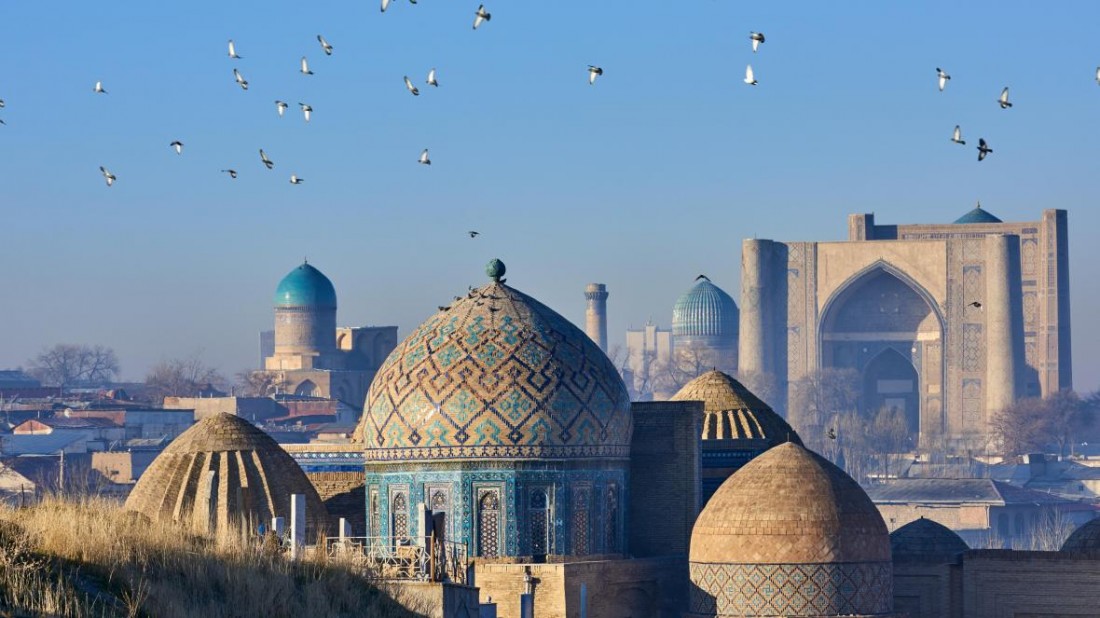
Empire of Amir Timur and the Timurids (XIV–XV centuries): The highest rise. Samarkand, the capital of the empire of Amir Timur (Tamerlane), has become a world center of science, art and architecture. This time gave the world such architectural masterpieces as Registan and the Ulugbek Observatory.
Sheibanids (XVI century): With the establishment of Sheibanid rule, the Bukhara, Khiva and, later, Kokand khanates flourished.
III. The era of the Khanates and the Entry into the Russian Empire (XVII–XIX centuries)
By the 18th century, the centralized state had weakened, giving way to three large feudal entities: the Emirate of Bukhara, the Khanates of Khiva and Kokand.
Geopolitical Changes: In the 19th century, the region became the scene of a confrontation between the Russian and British Empires (the "Big Game"). By the 1860s, most of the territory was annexed to the Russian Empire as the Turkestan General Government.
IV. XX Century: The Soviet Period and Independence
Soviet Era (1917-1991): After the October Revolution, the Uzbek Soviet Socialist Republic (UzSSR) was established. This period brought industrialization, secularization and significant social changes, but was accompanied by ideological control and restriction of national traditions.
Independence (August 31, 1991): With the collapse of the USSR, Uzbekistan declared its independence, becoming the Republic of Uzbekistan.
Today, Uzbekistan is actively reviving its cultural heritage, developing its economy and strengthening its role as a key player in the Central Asian region.